

Quick answer: Pakistani students applying for the GKS Scholarship Pakistan 2027 should first determine whether they are applying for an undergraduate or graduate program and then check the available application track. For the 2027 undergraduate cycle, applications are submitted through the Study in Korea system for the Embassy Track or directly to a participating Korean university for the University Track. Applicants must meet the nationality, age, education, and academic requirements and submit the required documents by the applicable deadline.
Pakistani students can apply for the Global Korea Scholarship (GKS) to study in South Korea through the Embassy Track or University Track, depending on the degree program and available options. The scholarship provides major financial support, including tuition support, airfare, Korean language training, and an allowance for scholars.
The 2027 GKS Undergraduate (GKS-U) guidelines have been officially released. The 2027 GKS-U University Track information was also published by Study in Korea on September 23, 2026. However, the general 2027 GKS Graduate (GKS-G) guidelines have not yet been published as of September 24, 2026.
Key Takeaways
- The 2027 GKS Undergraduate guidelines are officially available.
- Undergraduate applicants must generally be under 25 and meet the required academic performance standard.
- Applicants can apply through the Embassy Track or University Track, depending on the program and eligibility.
- The scholarship provides tuition support, airfare, Korean language training, and an annual allowance.
- The 2027 GKS Graduate guidelines are not yet available. Graduate applicants should wait for the official announcement rather than relying on unverified 2027 dates or requirements.
- Pakistani applicants should check the Korean Embassy in Pakistan and Study in Korea for country-specific instructions and deadlines.
What Is the GKS Scholarship?
The Global Korea Scholarship (GKS) is a Korean government scholarship program administered by the National Institute for International Education (NIIED).
It supports international students who want to pursue higher education in South Korea. The program is intended to promote international educational exchange and strengthen relationships between Korea and participating countries. GKS includes undergraduate and graduate programs, with separate application guidelines and selection schedules for each level.
What Does the GKS Scholarship Cover?
The exact benefits depend on the applicable year’s guidelines. For the 2027 undergraduate program, the scholarship provides major financial support during the Korean language and degree periods.
| Benefit | GKS 2027 Undergraduate Support |
|---|---|
| Airfare | Economy-class airfare under the program rules |
| Tuition | NIIED provides tuition support up to the stated limit, with the university covering applicable remaining tuition and admission fees under the 2027 guidelines |
| Korean Language Training | Support for the Korean language training program |
| Allowance | KRW 13,560,000 per year during the language program and KRW 14,400,000 per year during the degree program |
| Health Insurance | Included within the applicable scholarship support |
| Other Support | The 2027 guidelines include support related to accommodation, Korean proficiency, TOPIK fees, settlement, and degree completion within the scholarship’s allowance structure |
The annual allowance amounts are approximately KRW 1.13 million per month during Korean language training and KRW 1.2 million per month during the degree program when divided by 12. The official guidelines state the annual figures.
How to Apply for GKS Scholarship Pakistan 2027
The application process depends on the track available for your program.
Embassy Track
For the Embassy Track, applicants apply through the Korean government’s designated application system and are initially screened by the Korean diplomatic mission responsible for their country.
For the 2027 GKS-U Embassy Track, applicants submit their applications online through the Study in Korea system. For the University Track, applicants apply directly to a participating GKS university according to the university’s instructions and deadline. Applicants should follow the instructions in the official 2027 guidelines and any additional instructions issued by the Korean Embassy in Pakistan.
The Embassy Track involves multiple stages. Passing the first stage does not mean that you have received the final scholarship award.
University Track
Under the University Track, applicants submit their applications directly to a participating Korean university according to the university’s instructions and deadline.
The available universities and departments vary by GKS program. Applicants should check the official 2027 University Information released by NIIED before selecting a university.
What Is the Difference Between the Embassy Track and University Track?
The main difference is where you submit your application and how the selection process begins.
| Embassy Track | University Track |
|---|---|
| First-stage selection is handled through the Korean Embassy or designated diplomatic mission | First-stage selection is handled by a participating Korean university |
| Applicants follow the country-specific instructions | Applicants follow the university’s application instructions |
| University choices depend on the applicable GKS guidelines | Applicants apply to a participating university according to the program rules |
| Further screening is conducted after the first round | Further selection involves NIIED and the relevant institutions |
What Are the Eligibility Requirements for the GKS Scholarship?
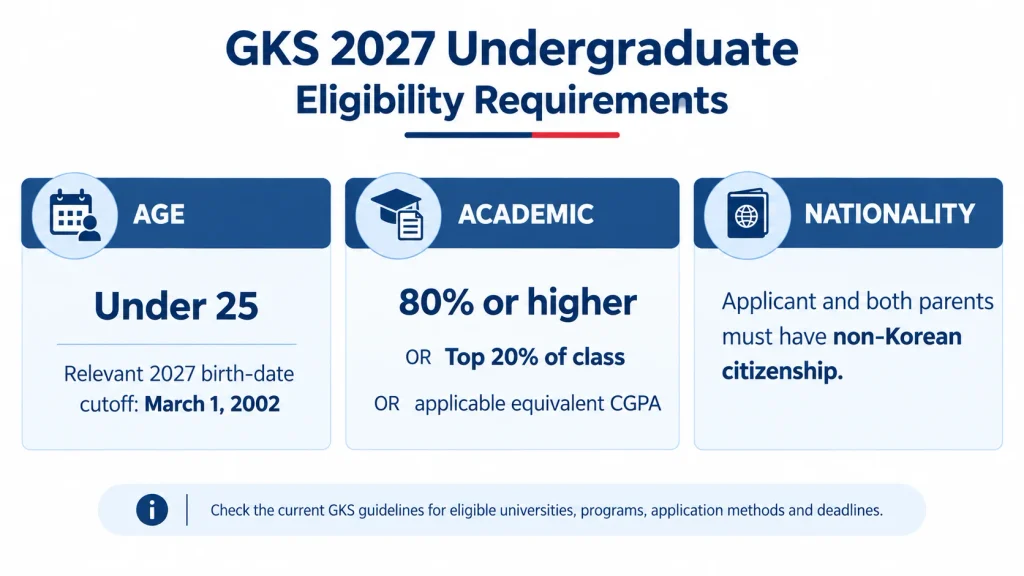
For the 2027 undergraduate program, applicants must satisfy the requirements set by NIIED.
Age Requirement
Applicants must be under 25 according to the applicable 2027 eligibility rules. The 2027 guidelines use March 1, 2002, as the relevant birth-date cutoff.
Academic Requirement
Applicants must meet at least one of the required academic standards. These include:
- A cumulative score of 80% or higher on a 100-point scale
- Ranking within the top 20% of the class
- Meeting the specified equivalent CGPA requirement, such as 2.64/4.0, 2.80/4.3, 2.91/4.5, or 3.23/5.0
Applicants using a class-ranking route must provide the required official documentation.
Nationality Requirement
The applicant and both parents must hold non-Korean citizenship. Applicants with Korean citizenship are not eligible under the standard international applicant requirements. Pakistani applicants should also confirm that Pakistan is included in the applicable 2027 country list and follow the specific instructions issued for Pakistani applicants.
What Documents Are Required for GKS?
The exact document list depends on the program and track, so applicants should use the official 2027 application forms and guidelines rather than an older checklist.
Documents can include:
- GKS application forms
- Personal statement
- Study plan
- Academic certificates and transcripts
- Proof of nationality
- Documents proving the nationality of both parents
- Recommendation letter
- Proof of graduation or expected graduation, where applicable
- Language test results, if available or required
- Other supporting documents specified by the selected university or GKS track
For Pakistani applicants, document authentication is particularly important. Follow the current instructions concerning Apostille or consular confirmation and do not wait until the final deadline to arrange document verification.
What Is the GKS 2027 Application Timeline?
The application schedule differs between undergraduate and graduate programs.
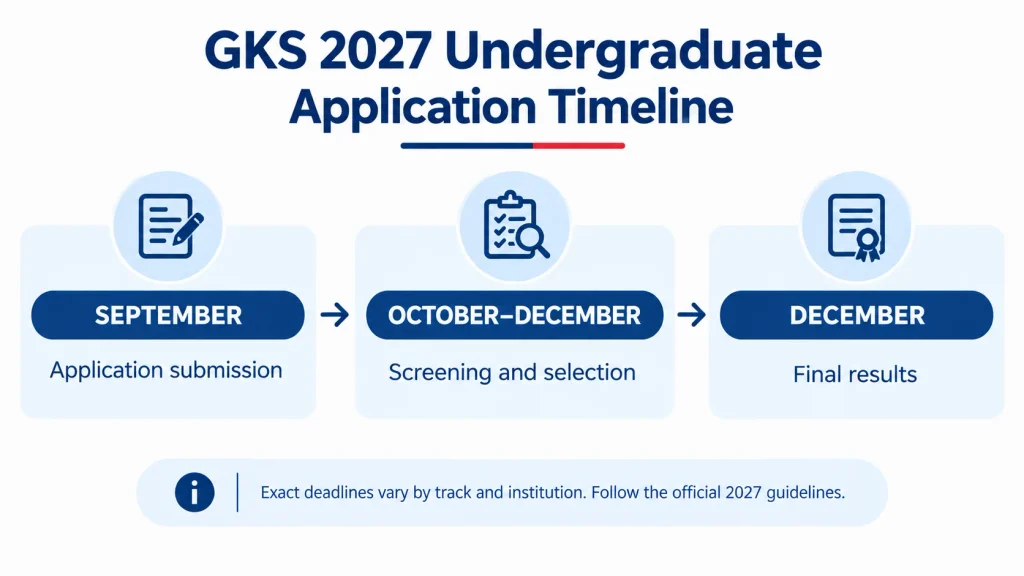
For GKS Undergraduate 2027, the official Study in Korea schedule places application submission in September for the Embassy Track and from September to November for the University Track, followed by screening and selection from October to December and final results in December.
The exact deadline can differ by track and institution. Applicants should follow the specific deadline shown in the 2027 guidelines and the instructions issued by the Korean Embassy or participating university.
What About GKS Graduate 2027?
The general 2027 GKS Graduate (GKS-G) application guidelines have not yet been published as of September 24, 2026.
The latest general GKS-G information currently available from Study in Korea is for the 2026 GKS-G cycle. Therefore, applicants planning for a Master’s or PhD should not treat 2026 dates, quotas, or requirements as confirmed 2027 information.
Study in Korea has published a separate 2027 GKS Korea-Japan Education Exchange Cooperation Program, which includes graduate-level opportunities. This is a separate program and should not be confused with the general GKS-G program.
Once NIIED releases the general 2027 GKS-G guidelines, applicants should check the official announcement for the confirmed eligibility criteria, university list, application dates, quotas, and required documents.
Do Pakistani Students Need IELTS for GKS?
IELTS is not a universal GKS requirement.
Language test requirements can depend on the GKS program, university, and department. Applicants should check the 2027 GKS guidelines and the requirements of their selected university before deciding whether they need IELTS, TOEFL, TOPIK, or another language qualification.
A language certificate may also be useful when applying to universities or departments that have their own language requirements.
Should You Learn Korean Before Applying?
You do not generally need to be fluent in Korean before applying for the GKS Scholarship in Pakistan. For programs that include Korean language training, selected scholars undertake the required language program before beginning their degree, subject to the rules of their scholarship program.
Learning basic Korean before travelling can still help with everyday communication and adjustment, but applicants should focus first on meeting the official eligibility and application requirements.
What Are the Main Challenges of GKS?
GKS is a competitive international scholarship, and applicants should prepare carefully.
The application requires accurate academic documents, strong written materials, and compliance with strict deadlines. Applicants also need to understand that receiving a scholarship nomination or passing one selection stage does not automatically guarantee final selection.
Students should also prepare for living and studying in a different country. Accommodation, food, transportation, and other living arrangements should be considered when planning for study in South Korea.
Plan Your GKS Application
The Global Korea Scholarship 2027 can provide Pakistani students with an opportunity to pursue higher education in South Korea with substantial financial support. Once the 2027 graduate guidelines are released, this guide should also be updated with the confirmed requirements and deadlines. For Pakistani students exploring international study opportunities, ScholarBee can help you understand university and scholarship options and plan your application journey.
Frequently Asked Questions
Can I apply for GKS 2027 if I am in my final year?
Yes, applicants who are expected to graduate can apply if they meet the applicable program’s graduation deadline and provide the required proof of expected graduation. The final graduation documents must then be submitted according to the official GKS schedule.
Is IELTS mandatory for Pakistani students applying for GKS?
No. IELTS is not a universal GKS requirement. However, a particular university or department may have its own language requirements, so applicants should check the requirements of their selected program.
What is the difference between GKS and KGSP?
GKS stands for Global Korea Scholarship. KGSP, or Korean Government Scholarship Program, was the former name commonly used for the scholarship. The program is now officially referred to as GKS.
Can I apply through both the Embassy Track and University Track?
Applicants should follow the 2027 guidelines regarding multiple applications. The rules can differ by program and track, so do not submit applications through multiple routes unless the official guidelines explicitly allow it.
How do I convert my Pakistani percentage to a 4.0 GPA?
NIIED provides specific GPA and percentage-equivalency requirements in its application guidelines. Applicants should use the conversion method and supporting documentation specified in the applicable 2027 guidelines rather than relying on an unofficial online conversion.
When will the 2027 GKS Graduate application open?
As of September 24, 2026, NIIED has not yet published the 2027 GKS Graduate application guidelines. The confirmed 2027 dates should be added once the official announcement is released.