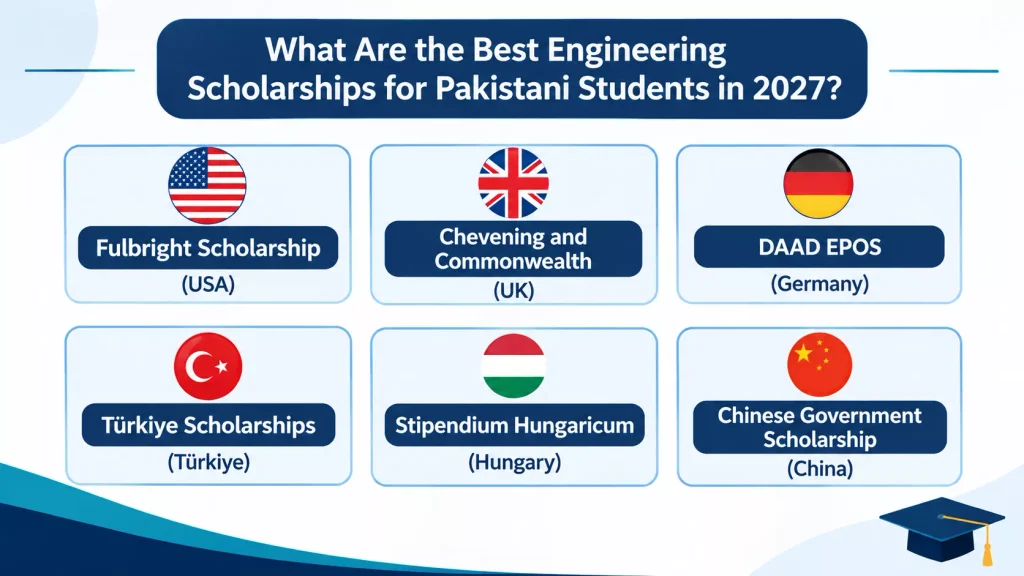
Quick answer: Pakistani students can explore engineering scholarships through programmes such as Fulbright (USA), Chevening and Commonwealth (UK), DAAD EPOS (Germany), Türkiye Scholarships, Stipendium Hungaricum (Hungary) and the Chinese Government Scholarship. Some 2027 scholarship applications have already closed, while other programmes have not yet announced their next application cycles. Students should check official scholarship announcements before preparing applications or relying on previous-year deadlines.
Pakistani engineering students can pursue higher education abroad through fully funded scholarships that cover tuition fees, living expenses and, depending on the programme, travel and health insurance. Countries such as the USA, UK, Germany, Türkiye, Hungary and China offer scholarship opportunities for international students in engineering and related fields.
However, finding the right scholarship requires more than good grades. Students must understand eligibility requirements, prepare their applications early and choose programmes that match their academic backgrounds and career goals.
Key Takeaways
- Consider opportunities in artificial intelligence, renewable energy, robotics, civil engineering and telecommunications.
- Fulbright, Chevening and Commonwealth applications for the 2027 intake have already closed.
- Arrange academic transcripts, degree certificates, recommendation letters and English-language test results where required.
- Work experience, academic requirements and language tests vary between scholarship programmes.
- Explain your engineering interests, academic experience and how your proposed studies connect with your future goals.
- Some scholarships require applications through both an international scholarship portal and Pakistan’s Higher Education Commission (HEC).
Why Study Engineering Abroad in 2027?
Studying engineering abroad gives Pakistani students opportunities to access international research facilities, advanced technologies and specialised academic programmes.
Universities in countries such as Germany, the USA and the UK offer programmes across several engineering disciplines. Depending on the institution, students may also have access to research projects, industry collaborations and practical training.
Engineering students can explore emerging and established specialisations, including:
- Artificial Intelligence and Machine Learning
- Renewable Energy Engineering
- Robotics and Automation
- Civil and Structural Engineering
- Electrical and Electronic Engineering
- Mechanical and Automotive Engineering
- Telecommunications and Computer Engineering
- Environmental Engineering
A fully funded scholarship can reduce the financial burden of studying internationally. Depending on the award, funding may cover tuition fees, accommodation, living expenses, health insurance and international travel.
However, scholarship benefits are not identical. Students should review the funding conditions of each programme before applying.
Another important consideration is the return-home requirement. For example, Pakistani Fulbright recipients must return to Pakistan and fulfil a minimum two-year residency requirement. Chevening scholars must also commit to returning to their home country for at least two years after completing their scholarship.
What Are the Best Engineering Scholarships for Pakistani Students in 2027?
Several international scholarship programmes accept students from Pakistan for engineering-related postgraduate studies. The following options include confirmed 2027 information as well as programmes whose next application announcements are still awaited.
1. Fulbright Scholarship (USA)
The Fulbright Degree Programme, administered in Pakistan by the United States Educational Foundation in Pakistan (USEFP), supports Pakistani students pursuing Master’s and PhD degrees in the United States.
Engineering students can apply for eligible programmes in areas such as computer engineering, electrical engineering, civil engineering and other technical disciplines.
Funding benefits include:
- University tuition fees
- Required textbooks
- International airfare
- Living stipend
- Health insurance
- Visa fees
- Computer and settling-in allowance
Eligibility and requirements:
Applicants must meet USEFP’s academic and programme-specific eligibility requirements. GRE requirements also apply, and applicants should check the current test and score requirements before applying.
Fulbright recipients are required to return to Pakistan within 30 days of completing their programmes and fulfil a minimum two-year residency requirement.
2027 application status: Applications for the 2027 Fulbright Programme are closed. USEFP announced an application deadline of 1 April 2026.
Students planning for a later intake should monitor the official USEFP website for the next application announcement rather than relying on previous deadlines.
2. Chevening Scholarship (UK)
The Chevening Scholarship is funded by the UK government and supports international students pursuing eligible one-year Master’s degrees at UK universities.
Engineering graduates interested in technology management, sustainable infrastructure, engineering policy and related fields can explore eligible Master’s programmes.
Funding benefits include:
- University tuition fees
- Monthly living allowance
- Travel costs to and from the UK
- Arrival and departure allowances
- Other eligible allowances under the programme
Eligibility and requirements:
Applicants must:
- Be citizens of a Chevening-eligible country, including Pakistan.
- Hold an undergraduate degree that qualifies them for a UK Master’s programme.
- Have at least 2,800 hours of work experience, equivalent to two years.
- Apply to three eligible UK university courses.
- Secure at least one unconditional university offer by the relevant deadline.
- Commit to returning to their home country for at least two years after completing the scholarship.
2027–28 application status: Applications opened in August 2026 and closed in October 2026. The application cycle is now closed.
Engineering graduates who missed this cycle can prepare for a future application by developing relevant professional experience and identifying suitable Master’s programmes.
3. Commonwealth Scholarship (UK)
The Commonwealth Scholarship Programme offers postgraduate funding for students from eligible Commonwealth countries, including Pakistan.
It is particularly relevant to engineering graduates whose proposed studies address development challenges. Areas such as science and technology, sustainable infrastructure, innovation and environmental development can connect with the programme’s development themes.
Funding benefits include:
- Approved university tuition fees
- Living allowance
- Approved travel expenses
- Other allowances depending on the scholarship category and applicable conditions
Eligibility and requirements:
Pakistani applicants must meet both HEC and Commonwealth Scholarship Commission requirements.
For the 2027–28 cycle, HEC specified:
- Pakistani or Azad Jammu and Kashmir nationality and permanent residency.
- A first-division Bachelor’s degree of 16 years of education for Master’s applicants.
- A first-division 17- or 18-year Master’s/MS/MPhil qualification for PhD applicants.
- A valid HEC HAT score of at least 60 out of 100.
- Compliance with the relevant Commonwealth eligibility requirements.
The 2027–28 programme included 26 Master’s nominations and 30 general PhD nominations through the HEC process.
2027–28 application status: The application deadline was 20 October 2026 for both the HEC and Commonwealth portals. Applications are now closed.
Students should remember that HEC nomination does not guarantee a final scholarship award. The Commonwealth Scholarship Commission makes the final selection.
4. DAAD EPOS Scholarship (Germany)
Germany is an important destination for engineering and technical education. The DAAD Development-Related Postgraduate Courses (EPOS) programme supports qualified graduates from developing and newly industrialised countries.
Pakistani engineering graduates can explore eligible postgraduate courses in areas such as renewable energy, water engineering, environmental engineering and other development-related disciplines.
Funding benefits include:
- Monthly scholarship payments
- Health, accident and personal liability insurance
- Travel allowance, subject to the programme conditions
- Possible additional allowances for rent and accompanying family members under specific conditions
For the published DAAD funding information, the monthly scholarship rate is €992 for graduates and €1,400 for doctoral candidates from February 2026.
Eligibility and requirements:
- Applicants generally need a relevant university degree.
- At least two years of professional experience after completing their degree is required.
- Their academic background must match the selected postgraduate course.
- Applicants must meet the individual university’s language and admission requirements.
Not every DAAD EPOS course is an engineering programme. Students should check the official course list and select a programme that matches their qualifications.
2027/28 application status: DAAD has published its 2027/28 EPOS course and application deadline information. Deadlines vary by university and course, so applicants should not rely on a single general deadline.
5. Türkiye Scholarships (Türkiye)
Türkiye Scholarships offers fully funded opportunities for international students pursuing Bachelor’s, Master’s and PhD degrees.
Pakistani engineering students can explore eligible programmes in civil, mechanical, electrical, computer and other engineering disciplines, depending on university availability.
Funding benefits include:
- University and department placement
- Tuition fees
- Monthly stipend
- Accommodation
- Health insurance
- One-year Turkish language course
- Flight ticket
Eligibility requirements:
The published general academic achievement criteria include:
- At least 70% for Bachelor’s applicants.
- At least 75% for Master’s and PhD applicants.
- At least 90% for applicants in medicine, dentistry and pharmacy.
Age requirements also apply:
- Bachelor’s: Under 21 years.
- Master’s: Under 30 years.
- PhD: Under 35 years.
Applicants must also meet the relevant programme and university requirements.
2027 application status: The official general application calendar lists 10 January to 20 February as the annual application period for full-time scholarships. Students planning for 2027 should monitor the official announcement for confirmation of the relevant dates.
6. Stipendium Hungaricum Scholarship (Hungary)
The Stipendium Hungaricum Scholarship, supported by the Hungarian Government, provides international students with opportunities to study at Hungarian universities.
Pakistani students can apply through the programme when eligible study fields and places are announced by HEC.
Engineering-related disciplines may include computer science, electrical engineering, mechanical engineering and other technical subjects, depending on the approved programme list.
Funding benefits include:
- Tuition-free education
- Monthly stipend
- Accommodation support or a housing contribution
- Medical insurance
The scholarship does not necessarily cover every personal expense. Students should review the funding conditions and budget for any additional costs.
Eligibility and application requirements:
- Applicants must meet the academic requirements of their selected degree.
- They must satisfy the relevant HEC and Hungarian university conditions.
- Some applicants may need to provide an English-language proficiency certificate or other accepted language evidence.
- Students must submit applications through the required scholarship portals.
2027 application status: HEC’s published information currently covers the 2026–27 scholarship cycle, which had a deadline of 15 January 2026. The next cycle’s official Pakistani application announcement and deadlines should be checked before applying.
7. Chinese Government Scholarship (China)
The Chinese Government Scholarship (CSC) provides opportunities for international students to pursue undergraduate, Master’s and PhD programmes at Chinese universities.
Pakistani engineering students can explore programmes in artificial intelligence, telecommunications, electrical engineering, mechanical engineering, civil engineering and other technical fields.
Funding benefits generally include:
- Tuition fees
- University accommodation or accommodation support
- Monthly stipend
- Medical insurance
Benefits and funding conditions depend on the scholarship category and applicable programme.
Eligibility and application requirements:
According to HEC’s published eligibility criteria for its Chinese Government Scholarship programme:
- Bachelor’s applicants must have completed Intermediate or equivalent education and be under 25.
- Master’s applicants must hold a 16-year Bachelor’s degree and be under 35.
- PhD applicants must hold an MS/MPhil or equivalent qualification and be under 40.
- Applicants must meet the academic and language requirements of their selected universities.
For HEC’s Type-A scholarship route, applicants must submit applications through both the official HEC application portal and the China Scholarship Council portal. The relevant application category and agency number must be selected correctly.
2027 application status: HEC’s latest published Chinese Government Scholarship announcement covers the 2026–27 cycle, which offered 75 seats for Pakistani students and had a deadline of 5 January 2026. The next cycle’s dates and available seats should not be assumed until HEC publishes an updated announcement.
Which Countries Offer Engineering Scholarships for Pakistani Students?
Different destinations offer different academic and funding opportunities. Your choice should depend on your engineering specialisation, preferred degree level, research interests and financial requirements.
| Country | Scholarship programme | Main opportunity |
|---|---|---|
| USA | Fulbright | Research-focused Master’s and PhD programmes |
| UK | Chevening | One-year Master’s programmes |
| UK | Commonwealth | Development-focused Master’s and PhD programmes |
| Germany | DAAD EPOS | Development-related postgraduate courses |
| Türkiye | Türkiye Scholarships | Bachelor’s, Master’s and PhD programmes |
| Hungary | Stipendium Hungaricum | Degree programmes at Hungarian universities |
| China | Chinese Government Scholarship | Undergraduate, Master’s and PhD programmes |
How Should Pakistani Students Apply for Engineering Scholarships Abroad?
A strong scholarship application requires careful planning. Follow these steps to improve your preparation.
1. Choose Your Engineering Specialisation
Start by identifying your academic interests and future career goals.
For example, a mechanical engineering graduate may consider renewable energy or automotive engineering, while a computer engineering graduate may explore artificial intelligence, cybersecurity or robotics.
Choose a programme that builds on your previous education rather than selecting a subject simply because it appears popular.
2. Check Scholarship Eligibility
Read the official eligibility criteria before starting an application.
Pay particular attention to:
- Required academic qualifications
- Minimum grades or CGPA
- Age restrictions
- Professional experience
- English-language requirements
- Research or university admission requirements
- Return-home obligations
For example, DAAD EPOS and Chevening have professional experience requirements, while other programmes may accept recent graduates.
3. Prepare Your Academic Documents
Most international scholarship applications require academic records and supporting documents.
Prepare the following where applicable:
- Matriculation and Intermediate certificates
- Bachelor’s or Master’s degree certificates
- Academic transcripts
- Updated CV or résumé
- Statement of Purpose
- Recommendation letters
- Valid passport
- Research proposal for relevant programmes
IBCC and HEC attestation requirements depend on the scholarship and university. Check the specific application instructions before arranging attestations.
4. Prepare for Language and Standardised Tests
Some universities and scholarships require IELTS, TOEFL or other recognised English-language evidence.
However, there is no universal IELTS score of 6.5 for every scholarship. Requirements depend on the institution, programme and scholarship.
Similarly, GRE requirements vary. Fulbright applicants should follow USEFP’s current GRE instructions, while other programmes may not require the examination.
Take the required tests early enough to receive your results before the application deadline.
5. Write a Strong Statement of Purpose
Your Statement of Purpose (SOP) should explain why you want to study engineering abroad and how the programme connects with your academic and professional goals.
A convincing SOP should include:
- Your academic background and engineering experience.
- Your interest in a specific engineering specialisation.
- Relevant projects, research or professional achievements.
- Reasons for selecting the university and programme.
- Your future career plans.
- How your education could contribute to engineering development in Pakistan.
Avoid generic statements about wanting to study at a prestigious university. Give specific examples that demonstrate your interests and preparation.
6. Research Universities and Professors
For research-based Master’s and PhD programmes, identify universities and research groups working in your chosen area.
Review faculty profiles, research publications and available laboratories. If contacting a professor is appropriate for the programme, send a concise and professional email explaining your academic background and research interests.
Do not assume that contacting a professor is compulsory for every scholarship.
7. Submit Applications Through the Correct Portals
Some scholarship programmes require applications through multiple platforms.
For example, Pakistani applicants to the HEC-administered Chinese Government Scholarship route must complete both HEC and CSC applications. Commonwealth applicants in the 2027–28 cycle also had to submit applications through both HEC and the Commonwealth portal.
Read the application instructions carefully and retain confirmation of every submitted application.
How Can You Improve Your Chances of Winning an Engineering Scholarship?
International scholarships are competitive, but a well-prepared application can help demonstrate your suitability.
Consider these practical steps:
- Build relevant experience: Participate in engineering projects, internships, research or technical activities.
- Develop technical skills: Learn tools and technologies relevant to your chosen engineering discipline.
- Choose suitable universities: Apply to programmes that match your academic background and career goals.
- Strengthen your application: Present your achievements clearly in your CV, SOP and recommendation letters.
- Follow official requirements: Missing documents, incorrect information or late submissions can make an application ineligible.
- Apply to multiple suitable programmes: Do not depend on a single scholarship when other eligible opportunities are available.
Always explore fully funded scholarships for international students to discover additional opportunities across different countries and academic fields before applying. Remember that a high CGPA alone does not guarantee a scholarship. Selection criteria differ, and some programmes place considerable importance on professional experience, research interests, leadership or development impact.
Find the Right Engineering Scholarship
Studying engineering abroad in 2027 can be an important step towards developing your academic knowledge and professional skills. However, the right opportunity depends on your qualifications, chosen specialisation and scholarship eligibility. ScholarBee helps students explore international universities and degree programmes.
Frequently Asked Questions
1. Can Pakistani students get fully funded engineering scholarships abroad in 2027?
Yes. Pakistani students can explore programmes such as Fulbright, Commonwealth, DAAD EPOS, Türkiye Scholarships, Stipendium Hungaricum and the Chinese Government Scholarship. However, application availability depends on the scholarship cycle, and some 2027 applications have already closed.
2. Can I apply for an engineering scholarship abroad without IELTS?
Yes, some universities accept alternative English-language evidence, such as a Medium of Instruction (MOI) certificate, depending on their admission policies. However, an MOI certificate is not accepted everywhere. Students must check the language requirements of their chosen university and scholarship before applying.
3. Is a 3.0 CGPA enough for a fully funded engineering scholarship?
A 3.0 CGPA may meet the minimum academic requirement for some programmes, but eligibility varies. Scholarship committees may also consider research experience, professional achievements, recommendation letters, academic projects and the quality of your application.
4. Do I need work experience to apply for an engineering Master’s scholarship abroad?
Not always. Work experience requirements depend on the scholarship. Other scholarships may accept recent graduates, provided they meet the academic and programme requirements.
5. What is the return-home requirement for Pakistani scholarship recipients?
Some government-funded scholarships require recipients to return to their home country after completing their studies. Always review the specific scholarship agreement before accepting an award.
6. When should Pakistani students start preparing for the 2027 engineering scholarship intake?
Students should begin preparing as early as possible. The preparation timeline depends on the scholarship and its application deadline. For the 2027 intake, some programmes have already closed their applications. Students should monitor upcoming opportunities, prepare their academic documents and complete any required language or standardised tests in advance.