Quick answer: Pakistani students can pursue medical education abroad, but fully funded MBBS scholarships are difficult to secure. Germany offers medical education at public universities with generally no tuition fees, subject to state and university-specific rules. However, medical programmes are primarily taught in German. The UK and Australia offer English-taught medical degrees, but international tuition fees can be substantial, and full undergraduate scholarships are limited.
Medical scholarships abroad provide Pakistani students with opportunities to explore international medical education through government-funded programmes, university financial aid and other funding options. However, fully funded scholarships for undergraduate medical degrees (MBBS or equivalent) are limited, particularly in countries such as the UK and Australia.
Before applying, students must check whether their chosen medical university meets the Pakistan Medical and Dental Council (PMDC) requirements for foreign medical graduates. A listing in the World Directory of Medical Schools (WDOMS) alone does not guarantee recognition in Pakistan.
Key Takeaways
- PMDC recognition matters: Check the recognised foreign undergraduate medical colleges before making an admission decision.
- Germany: Public universities generally do not charge tuition fees, but students must meet German-language and academic admission requirements.
- United Kingdom: Most undergraduate medical courses require the UCAT. The 2027 entry UCAS deadline for most medical courses was 15 October 2026.
- Australia: International medical students should check individual university admission requirements and available scholarships.
- Scholarships: Many well-known international scholarships support postgraduate study rather than initial medical degrees.
- Licensing: Graduating from a foreign medical university does not automatically grant permission to practise medicine in Pakistan or another country.
Why Is PMDC Recognition Important for Pakistani Medical Students?
PMDC recognition is an important consideration for Pakistani students planning to complete their medical education abroad and return to Pakistan. Before accepting an admission offer, students should:
- Check whether the medical university appears on the PMDC’s recognised foreign undergraduate colleges list.
- Verify the institution and its medical programme in the World Directory of Medical Schools.
- Review PMDC requirements for foreign medical graduates, including applicable registration and licensing examinations.
- Confirm that the university, programme and qualification meet the requirements applicable to their admission year.
Important: Appearing in the World Directory of Medical Schools does not itself mean that a medical school is recognised, accredited or endorsed. Students should not use WDOMS as a substitute for checking PMDC requirements.
Students who intend to practise internationally must also meet the licensing requirements of their destination country.
For example:
- United Kingdom: The General Medical Council (GMC) has registration routes for international medical graduates. Requirements depend on the applicant’s qualifications and circumstances.
- Australia: International medical graduates may need to complete an applicable registration pathway, such as the AMC Standard Pathway.
- United States: International graduates must meet the applicable Educational Commission for Foreign Medical Graduates (ECFMG) certification and examination requirements.
What Is the Difference Between MBBS and MD?
MBBS and MD are medical qualifications, but their meaning and entry requirements vary between countries.
MBBS (Bachelor of Medicine, Bachelor of Surgery) is generally an undergraduate-entry medical qualification in countries such as Pakistan and the UK.
In the United States and Canada, an MD (Doctor of Medicine) is generally a professional medical degree pursued after completing the required undergraduate education.
| Feature | MBBS (Pakistan, UK and other countries) | MD (USA and Canada) |
|---|---|---|
| Entry route | Usually after secondary education | Usually after undergraduate study |
| Programme duration | Commonly 5–6 years, depending on the country | Usually 4 years |
| Previous degree | Not generally required | Usually a bachelor’s degree is required |
| Admission examinations | Varies by university and country | MCAT is commonly required |
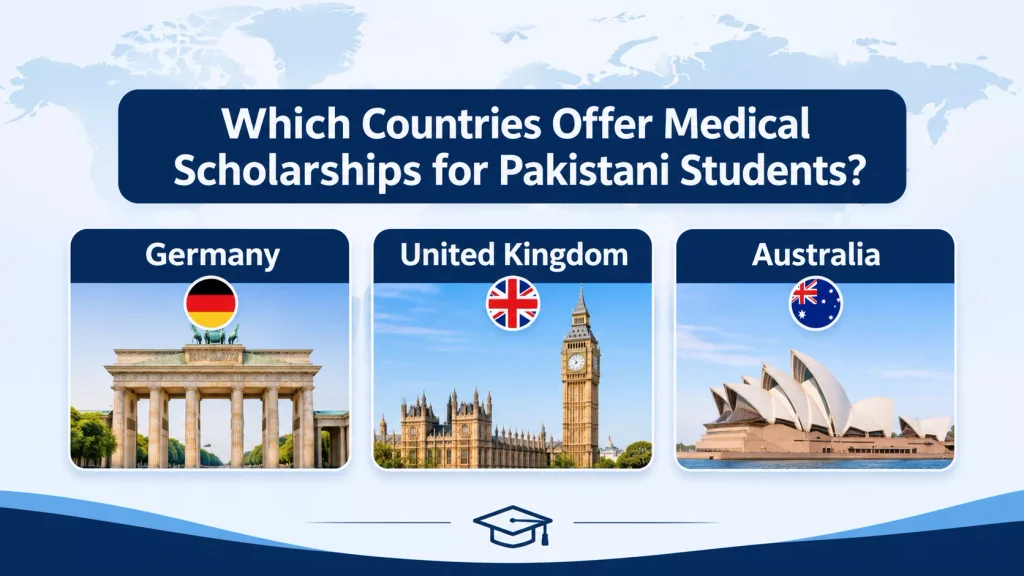
Which Countries Offer Medical Scholarships for Pakistani Students?
Germany, the UK and Australia are possible destinations for Pakistani students interested in medical education. However, their tuition structures, scholarship opportunities and admission requirements differ considerably.
Germany
Germany is worth considering because many public universities do not charge general tuition fees for undergraduate programmes. However, this does not mean that studying medicine is completely free.
Students may still need to pay semester contributions, living expenses and other applicable charges. Some states and universities also charge tuition fees to certain international students.
Language Requirements
Medicine programmes at German public universities are generally taught in German. International applicants normally need strong German-language proficiency, with the exact requirement determined by the university.
Pakistani students must also check whether their FSc or A-Level qualification provides direct university admission. Depending on their educational background, they may need to complete a preparatory course (Studienkolleg) and pass the relevant assessment examination.
For medicine, the relevant preparatory subject area is the M-course.
Scholarship Opportunities
Students should investigate funding through the following routes:
- DAAD Scholarships: The German Academic Exchange Service offers several scholarship programmes, mainly for graduates, postgraduate students, researchers and doctoral candidates. Students should not assume that DAAD provides a fully funded scholarship for a complete undergraduate medical degree.
- University Funding: Individual universities and external organisations may offer financial assistance. Eligibility depends on the programme and applicant’s academic background.
- Other Funding Programmes: Students can search available scholarship opportunities according to their qualifications and intended study level.
DAAD identifies graduates, doctoral students and postdoctoral researchers as the main target groups for many of its scholarship programmes.
The DAAD scholarship programmes and eligibility information can help students understand which funding opportunities match their academic level.
The United Kingdom
The United Kingdom offers undergraduate medical programmes, commonly lasting five or six years depending on the course. International students can apply, provided they meet the university’s academic, examination and English-language requirements.
However, fully funded scholarships covering the complete tuition and living costs of an international undergraduate medical degree are limited.
Scholarship Opportunities
Pakistani students should investigate university-specific financial support and international scholarship programmes. Some commonly mentioned awards require particular attention:
- Rhodes Scholarship: This is a prestigious University of Oxford scholarship for eligible postgraduate study. It is not a general undergraduate MBBS scholarship. Pakistani applicants must meet the relevant constituency requirements.
- Cambridge Trust Funding: The University of Cambridge offers financial support to international undergraduate students, but full undergraduate scholarships are limited. Most available support is partial and subject to individual eligibility and financial assessment.
- University Scholarships: Medical schools may offer entrance awards or financial assistance. However, students must check whether these are available to international medical students.
Admission Requirements for 2027
Students applying for undergraduate medicine in the UK should pay attention to the following:
- Apply through UCAS.
- Meet the university’s required academic grades.
- Take the UCAT if required by the chosen medical school.
- Meet the university’s English-language requirements.
- Complete any required interviews and additional admission assessments.
The BMAT should not be included as a current general admission requirement. Students must check individual universities’ current entry criteria.
2027 application deadline: The UCAS equal consideration deadline for most undergraduate medicine courses beginning in 2027 was 15 October 2026 at 18:00 UK time. This deadline has already passed as of November 2026. Students should contact universities directly to check whether any eligible late application options remain.
Australia
Australia offers undergraduate and graduate-entry medical programmes. International students can apply to eligible courses, but admission requirements, programme duration and tuition fees vary by university.
Students should not assume that an Australian medical degree automatically provides a pathway to permanent residency or medical registration. Graduates must satisfy the applicable Medical Board of Australia registration requirements.
Scholarship Opportunities
Pakistani students can investigate two main funding routes:
- Australia Awards Scholarships: The Australian Government publishes country-specific scholarship requirements. The 2027 intake information for Pakistan is available. However, applicants must check the approved fields of study and eligibility conditions. These awards should not be presented as general undergraduate MBBS scholarships.
- University Scholarships: Australian universities publish their own scholarship opportunities for international students. Some awards are available for particular undergraduate or postgraduate programmes, while others have restrictions on eligible courses.
The University of Sydney, for example, publishes separate scholarship information for international students in its Faculty of Medicine and Health. Students should check the individual award’s value and eligibility rather than assuming it covers the full cost of a medical degree.
Admission Requirements
Depending on the university and programme, applicants may need:
- Recognised secondary or undergraduate qualifications.
- Required academic grades in science subjects.
- An English-language test score meeting the university’s standard.
- An admission test where applicable.
- An interview or other selection assessment.
The UCAT, ISAT and other assessments are not universal requirements for every Australian medical programme. Check the selected university’s official admission information before registering for a test.
Medical Registration in Australia
International medical graduates must follow an applicable registration pathway. Under the AMC Standard Pathway, applicants generally need to pass the AMC CAT MCQ examination and either the AMC Clinical Examination or an approved workplace-based assessment.
When Should Pakistani Students Start Preparing for Medical Scholarships in 2027?
Students planning to begin medical studies in 2027 should prepare well before university application deadlines. Medical admissions often involve additional examinations, interviews and document verification.
Students considering international education can also learn about funding routes, eligibility and available opportunities through our guide to the best international scholarships for Pakistani students.
| Period | Recommended Preparation |
|---|---|
| November–December 2026 | Check universities accepting applications, verify PMDC recognition and review scholarship eligibility. |
| January–March 2027 | Prepare for any remaining university applications, interviews and admission requirements. |
| April–June 2027 | Review admission decisions, complete document verification and prepare for visa applications where applicable. |
| Before enrolment | Confirm tuition arrangements, scholarship awards, accommodation and registration requirements. |
Essential Documents for Medical University Applications
Prepare the following documents according to the requirements of your selected university and scholarship provider:
- FSc Pre-Medical or A-Level certificates and transcripts.
- IBCC equivalence certificate, where required.
- Valid Pakistani passport.
- English-language proficiency test results, if required.
- UCAT or another relevant admission examination result, if applicable.
- Personal statement or Statement of Purpose (SOP), where required.
- Academic references or recommendation letters, if requested.
- Evidence of extracurricular activities or relevant experience, where required.
- Financial documents for scholarship or student visa applications, where applicable.
Document requirements differ between universities. Students should follow the official application checklist rather than assuming that every institution requires the same documents.
How Can Pakistani Students Choose the Right Medical Scholarships Abroad?
Finding a scholarship is only one part of planning medical education abroad. Students should also consider whether the medical degree will allow them to pursue their intended career.
Before applying, follow these steps:
- Select Your Destination: Compare Germany, the UK and Australia based on language, tuition costs and admission requirements.
- Identify Recognised Medical Universities: Check the PMDC foreign undergraduate college list before making a financial commitment.
- Find Relevant Funding: Search for scholarships that specifically accept international medical students at your intended study level.
- Check the Coverage: Determine whether the award covers tuition fees, living expenses, travel or only a portion of the total cost.
- Review Licensing Requirements: Understand the examinations and registration conditions for practising medicine in Pakistan or your intended destination.
- Confirm Application Deadlines: Check the university and scholarship provider’s official websites for the latest dates.
Students comparing the financial commitment of medical education should also consider how tuition costs, clinical exposure and institutional facilities differ. These factors are discussed in our guide to government versus private medical colleges’ fee structures and value in Pakistan.
Plan Your Medical Education Abroad Carefully
Studying medicine abroad can provide Pakistani students with access to different medical education systems. However, choosing a university based only on tuition costs or scholarship availability can create problems later. PMDC recognition, academic eligibility, language requirements and medical licensing rules should all be considered before accepting an admission offer. ScholarBee helps students explore universities, academic programmes and scholarship information in one place.
Frequently Asked Questions
1. Is MDCAT Required for Pakistani Students Who Want to Study MBBS Abroad?
MDCAT requirements for admission to foreign medical universities should be distinguished from the requirements for admission to Pakistani medical colleges. PMDC has published notices concerning the requirements for students seeking admission to foreign institutions. Students should check the latest PMDC notices and applicable foreign medical graduate regulations before applying.
2. Can Pakistani Students Study MBBS in Germany in English?
Most medical degree programmes at German public universities are taught in German. Students generally need advanced German-language proficiency to meet university admission and clinical training requirements.
3. Can I Get a Fully Funded MBBS Scholarship in the UK?
Fully funded undergraduate medical scholarships for international students are limited. Some universities provide financial assistance or entrance awards, but these do not necessarily cover complete tuition fees and living expenses. Students should check the eligibility and funding coverage of each scholarship before applying.
4. What Is the Difference Between PLAB, AMC and USMLE?
These are different medical examination systems associated with medical registration and licensing pathways.
PLAB: An examination route used by eligible international medical graduates seeking registration with the UK’s General Medical Council.
AMC Examinations: Assessments used in the Australian Medical Council’s Standard Pathway for eligible international medical graduates.
USMLE: The United States Medical Licensing Examination, which forms part of the examination requirements for medical licensure in the United States.
5. Can Pakistani Medical Graduates Get Permanent Residency in Australia?
Completing a medical degree in Australia does not automatically qualify a graduate for permanent residency. Graduates must meet the applicable immigration requirements. Medical registration and migration eligibility are separate processes, and both depend on the individual’s circumstances and the rules in force at the time of application.
6. What Is a Studienkolleg in Germany?
A Studienkolleg is a preparatory institution for international applicants whose school-leaving qualifications do not provide direct access to German university education. Students applying for medicine may need the M-course (Medizin course), followed by the required assessment examination.