


Quick answer: A chartered university is a legally established higher education institution with the authority to award degrees under its own name. An affiliated college is an institution authorized to offer specified undergraduate programmes under an affiliating university or Degree Awarding Institution (DAI). The affiliating university controls the academic framework, conducts examinations, and awards the qualification. Your decision should depend on the programme, institutional recognition, teaching facilities, fees, and academic requirements rather than the institution’s name alone.
Understanding the difference between a chartered university vs affiliated college in Pakistan can help students make informed decisions about their higher education. Although both routes can lead to a university degree, they differ in academic administration, curriculum, examinations, and institutional responsibilities.
Understanding these differences can help students select an institution that meets their academic requirements and future plans.
Key Takeaways
- Chartered universities and DAIs have independent legal authority to award degrees within their approved scope.
- Affiliated colleges offer programmes under an affiliating university or DAI.
- Under HEC’s 2024 revised affiliation policy, public-sector universities/DAIs may affiliate eligible public- and private-sector colleges.
- Affiliated colleges must follow the affiliating university’s curriculum and applicable academic policies.
- The affiliating university conducts and evaluates examinations leading to the award of degrees.
- HEC’s policy requires the affiliated college’s name to appear on both the transcript and degree.
- Students should verify the university, college, campus, and specific programme before taking admission.
What Is a Chartered University in Pakistan?
A chartered university is a higher education institution established under a legal charter granted through the relevant legislative or governmental process. In Pakistan, universities and Degree Awarding Institutions (DAIs) operate under their respective legal frameworks and are subject to applicable higher education regulations.
A recognized chartered university or DAI has the legal authority to award degrees within its approved academic scope.
Main Responsibilities of a Chartered University
A chartered university generally manages its own academic and administrative arrangements, subject to applicable HEC requirements and its governing charter.
Its responsibilities include:
- Establishing academic programmes within its approved scope.
- Developing and implementing curricula.
- Appointing teaching and administrative staff.
- Managing examinations and assessment systems.
- Maintaining academic records.
- Awarding degrees to eligible graduates.
The specific authority and responsibilities of an institution depend on its charter and applicable regulatory requirements.
What Is an Affiliated College in Pakistan?
An affiliated college is an educational institution that offers academic programmes under an affiliation arrangement with a university or Degree Awarding Institution.
Unlike an independent degree-awarding institution, an affiliated college does not award its own university degrees. The affiliating university is responsible for the academic framework and final qualification.
How Does an Affiliated College Work?
The relationship between an affiliated college and its parent university involves several responsibilities:
- Teaching: The college provides classes, teaching staff, and required academic facilities.
- Curriculum: Students follow the curriculum approved and offered by the affiliating university.
- Examinations: The affiliating university conducts and evaluates examinations leading to the award of degrees.
- Academic records: The university maintains responsibility for the relevant academic and degree-awarding arrangements.
- Degree issuance: The degree is issued under the authority and seal of the affiliating university.
Students should remember that affiliation applies to specific approved programmes. A college’s affiliation in one programme does not automatically establish approval for every programme it advertises.
What Is the HEC Institutional Affiliation Policy 2024?
The Higher Education Commission introduced the revised Institutional Affiliation Policy 2024 to establish requirements for universities and colleges involved in affiliation arrangements.
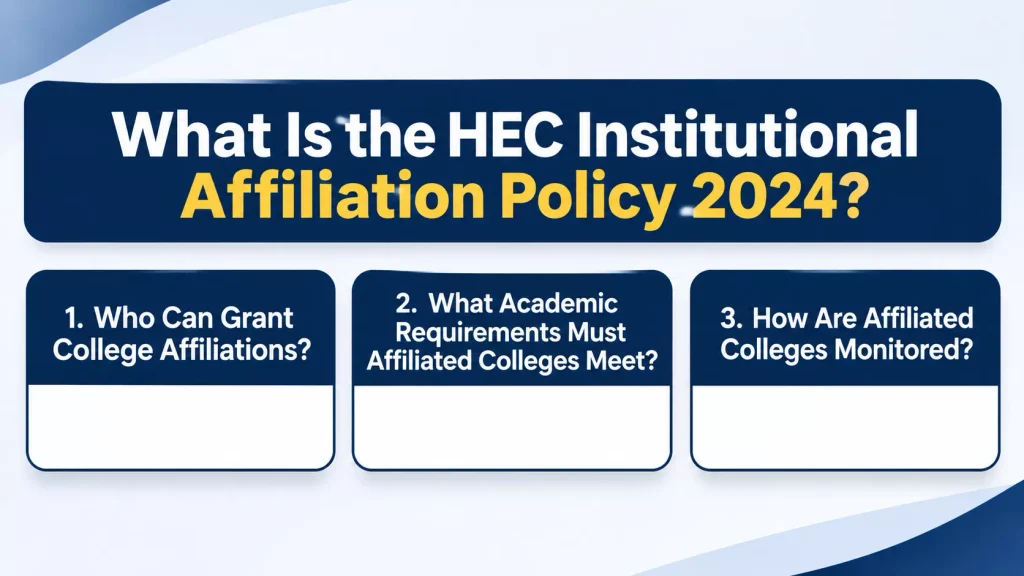
The policy sets conditions relating to institutional eligibility, academic programmes, faculty qualifications, infrastructure, examinations, and quality assurance. These requirements are outlined in the HEC Institutional Affiliation Policy 2024.
Who Can Grant College Affiliations?
Under the revised policy, public-sector universities and Degree Awarding Institutions can grant affiliations to eligible colleges and institutes in the public and private sectors.
The affiliating university or DAI must:
- Have legal authority to affiliate colleges under its governing Act.
- Operate for at least three years before granting affiliations.
- Offer the relevant academic programme for at least three years.
- Follow its legally defined territorial jurisdiction and applicable policy requirements.
- Obtain approval through its prescribed statutory and affiliation procedures.
The policy also limits affiliations to undergraduate programmes.
What Academic Requirements Must Affiliated Colleges Meet?
The policy establishes requirements for affiliated colleges, including:
- Qualified teaching staff.
- Appropriate classrooms and academic infrastructure.
- Libraries and relevant laboratory facilities.
- Internet access for students and faculty.
- Compliance with applicable professional accreditation requirements.
- Implementation of the affiliating university’s academic and quality assurance policies.
For faculty, the policy specifies a minimum academic qualification of MS/MPhil or 18 years of education, subject to relevant accreditation council requirements.
How Are Affiliated Colleges Monitored?
The affiliating university is responsible for monitoring its affiliated colleges.
Under the revised policy:
- The university’s Affiliation Committee must conduct random visits at least twice a year.
- The university must maintain relevant college information through the HEC portal.
- Monitoring and evaluation reports are compiled on a three-year cycle.
- The affiliating university’s quality assurance policy must also apply to its affiliated colleges.
These requirements are intended to maintain academic standards across affiliated institutions.
What Are the Key Differences Between a Chartered University vs Affiliated College?
The key differences between a Chartered university and an Affiliated college are as following:
| Comparison | Chartered University / DAI | Affiliated College |
|---|---|---|
| Legal status | Independently established under its legal charter | Operates under an affiliation arrangement |
| Degree-awarding authority | Awards degrees within its approved authority | Does not independently award university degrees |
| Curriculum | Manages its approved academic curriculum | Follows the affiliating university’s curriculum |
| Teaching | Provides teaching through its own departments | Provides teaching through college faculty |
| Examinations | Manages its examination system | Examinations are conducted and evaluated by the affiliating university |
| Academic policies | Implements applicable HEC and institutional policies | Follows HEC and affiliating university policies |
| Degree | Issued under its own authority | Issued by the affiliating university |
| Academic records | Maintains its institutional records | Operates under the affiliating university’s academic framework |
How Do These Differences Affect Your Education?
The institutional structure can influence your daily academic experience, learning environment, and access to facilities.
Academic Autonomy and Curriculum
A chartered university manages its own approved academic programmes and curriculum through its institutional academic bodies.
An affiliated college follows the curriculum of its affiliating university. Under the HEC 2024 policy, the courses and syllabi taught at the college must be the same as those offered by the affiliating university.
Students should therefore compare the actual programme curriculum rather than assume that every university offers a more updated course structure. Understanding what credit hours mean in universities can also help students assess programme requirements and the academic workload associated with their chosen degree.
Examination Systems and Assessment
The examination arrangement is another important difference.
Chartered universities manage their own examination and assessment systems according to their academic regulations.
For affiliated colleges, the HEC policy specifies that the affiliating university conducts and evaluates examinations leading to the award of degrees.
The policy also requires affiliated colleges to follow the semester system and applicable CGPA arrangements.
Degree Recognition and International Study
A degree from an affiliated college is awarded by the affiliating university rather than the college itself.
However, students should not assume that every affiliated college or programme is automatically recognized simply because a university is recognized by HEC.
Recognition depends on the relevant institution, affiliation, programme, and applicable regulatory requirements.
For international education or employment, the receiving university, employer, licensing authority, or credential evaluation organization may apply its own requirements.
Students planning to use their qualifications abroad should also understand the HEC degree attestation process and requirements, particularly when their documents need official verification.
What Are the Pros and Cons of Each Option?
Both educational arrangements have advantages and limitations. The actual student experience depends on the institution and programme.
Chartered University
Advantages
- Direct degree-awarding authority.
- Institutional control over approved academic programmes.
- Access to the university’s academic departments and facilities.
- Institutional examination and assessment arrangements.
- Opportunities to participate in university-level academic and research activities.
Considerations
- Tuition fees vary considerably between institutions.
- Admission requirements differ by university and programme.
- Campus facilities and academic resources vary.
- Students may need to relocate depending on the university’s location.
Affiliated College
Advantages
- Provides access to university programmes through a separate college campus.
- Students may have a local option without relocating to the university’s main campus.
- Follows the academic framework of its affiliating university.
- Benefits from the university’s examination and degree-awarding arrangements.
Considerations
- Cannot independently award university degrees.
- Must follow the affiliating university’s curriculum.
- Examination arrangements are managed by the affiliating university.
- Facilities and teaching resources must be evaluated at the individual college.
- Affiliation and programme approval must remain valid.
How to Check Whether an Affiliated College Is Recognized by HEC
Before applying to an affiliated college, students should verify its status instead of relying solely on advertisements or admission claims.
Follow these steps:
- Check whether the affiliating university or DAI appears on HEC’s recognized institutions list.
- Confirm that the specific college is recognized as an affiliated institution.
- Verify that the particular degree programme is covered by the affiliation.
- Check the relevant professional accreditation requirements if you are applying for a regulated programme.
- Confirm the affiliation status for your intended admission session directly with the university.
Students can cross-check institutional status through the HEC Recognised Universities and Degree Awarding Institutions list.
This is particularly important because recognition of a parent university does not automatically establish the recognition of every college operating under its name.
Make a Proper Decision
A chartered university provides an independent institutional academic environment, while an affiliated college offers programmes under the academic and degree-awarding framework of its affiliating university. Before making a decision, verify the institution’s HEC recognition, the college’s affiliation, and the approval of your chosen programme. ScholarBee helps students compare universities and academic options in Pakistan so they can make informed decisions about their higher education.
Frequently Asked Questions
1. What is the difference between a chartered university and an affiliated college?
A chartered university has independent legal authority to award degrees within its approved scope. An affiliated college provides teaching for programmes offered under an affiliating university, which awards the final degree.
2. Can an affiliated college issue its own university degree?
No. Under the HEC affiliation framework, the affiliating university or DAI awards the degree under its authority and seal.
3. Can private colleges get affiliation from public universities?
Yes. The HEC Institutional Affiliation Policy 2024 allows eligible public-sector universities and DAIs to affiliate colleges in both the public and private sectors, subject to the policy and applicable legal requirements.
4. Does an affiliated college follow its own syllabus?
No. An affiliated college must follow the courses and syllabus offered by its affiliating university for the relevant programme.
5. Who conducts examinations at affiliated colleges?
The affiliating university conducts and evaluates examinations leading to the award of degrees and diplomas.
6. Does the affiliated college’s name appear on the degree?
Yes. Under Clause 23 of the revised HEC Institutional Affiliation Policy 2024, the affiliating university must mention the affiliated college’s name on both the student’s transcript and degree.
7. Is a degree from an affiliated college recognized internationally?
International acceptance depends on the receiving institution, employer, credential evaluator, or relevant authority. Students should verify the recognition status of their institution and programme and check the requirements of the organization to which they intend to apply.
