


Quick answer: Universities calculate merit by multiplying your percentage in each qualification or entrance examination by its assigned weightage and adding the results. There is no single merit formula followed by every Pakistani university. Always check the admission criteria for your selected programme and admission session. The 2027 admission criteria have not been established in the official documents used for this guide. The university examples below use the latest verifiable published criteria, including 2026 policies where available.
To calculate university merit in Pakistan, students need to combine their Matriculation (SSC), Intermediate (HSSC), and entrance test scores according to the weightage assigned by their selected university. Each university assigns different weightage to these qualifications, which determines your final merit aggregate and position on the admission list.
This guide explains how to calculate your university merit aggregate, understand admission weightage, convert O-Level and A-Level grades through IBCC, and calculate your expected admission score.
Key Takeaways
- University merit is calculated using a weighted aggregate of academic marks and entrance test results.
- Different universities assign different weightages to Matric, Intermediate and entrance examinations.
- NUST uses 75% NET, 15% HSSC and 10% SSC for its general NET-based undergraduate admissions.
- FAST-NUCES uses different selection formulas for engineering and other undergraduate programmes.
- O-Level and A-Level students need the relevant IBCC equivalence to calculate their academic percentages.
- Some universities calculate initial merit using HSSC Part-I results when the complete HSSC result is unavailable.
- Eligibility requirements and merit aggregates are different. Meeting the minimum eligibility criteria does not guarantee admission.
What Is University Merit Aggregate and Why Does It Matter?
A university merit aggregate is the final percentage calculated by an institution to evaluate applicants for admission. It combines academic qualifications and, where applicable, entrance test performance.
Universities use this aggregate to rank eligible applicants for available seats in their programmes.
For example, two students applying for the same BS Computer Science programme may have different merit aggregates even if their Intermediate marks are similar. Their entrance test scores and the university’s weightage formula can change their final positions.
Admission requirements also depend on the relevant regulatory framework:
- Higher Education Commission (HEC): Provides the higher education regulatory and policy framework for recognized universities and degree-awarding institutions. Students can verify an institution through the HEC list of recognized universities and degree-awarding institutions.
- Pakistan Medical and Dental Council (PMDC): Establishes admission regulations and standards for undergraduate medical and dental education.
- Pakistan Engineering Council (PEC): Sets professional standards and accredits engineering qualifications. Applicants can check the PEC engineering programme accreditation information when evaluating engineering programmes.
Students should distinguish between minimum eligibility requirements, entrance test requirements and the aggregate used to rank applicants.
What Is the University Merit Formula in Pakistan?
Although universities use different weightages, the basic mathematical method remains the same.
General University Merit Formula
Merit Aggregate (%) = [(SSC Obtained Marks ÷ SSC Total Marks) × SSC Weightage] + [(HSSC Obtained Marks ÷ HSSC Total Marks) × HSSC Weightage] + [(Entry Test Obtained Marks ÷ Entry Test Total Marks) × Entry Test Weightage]
Explanation:
- SSC: Matriculation marks.
- HSSC: Intermediate marks.
- Entry Test: Marks obtained in the university’s required admission test.
- Weightage: Percentage assigned to each component by the university.
Example using 10:40:50 weightage:
Merit Aggregate = [(1020 ÷ 1100) × 10] + [(430 ÷ 520) × 40] + [(78 ÷ 100) × 50]
Merit Aggregate = 9.27 + 33.08 + 39
Final Aggregate = 81.35%
Enter weightages as 10, 40 and 50, not 0.10, 0.40 and 0.50, in this version of the formula.
How Does Merit Weightage Differ Across Pakistani Universities?
There is no universal admission formula across Pakistani universities. The following comparison uses the latest official criteria that could be verified for the respective institutions.
| University / Authority | Programme or admission category | Matric / SSC | Intermediate / HSSC | Entry Test |
|---|---|---|---|---|
| PMDC | Public MBBS and BDS merit | 10% | 40% | 50% MDCAT |
| NUST | General NET-based UG admissions | 10% | 15% | 75% NET |
| FAST-NUCES | Engineering | 17% | 50% | 33% |
| FAST-NUCES | Computing and listed business programmes | 10% | 40% | 50% |
| UET Lahore | ECAT-based programmes, Intermediate applicants | 17% | 50% | 33% |
| COMSATS | Undergraduate programmes, 2025–26 prospectus | 10% | 40% | 50% NTS |
| Quaid-i-Azam University | Other undergraduate programmes | 30% | 70% | No separate entry-test weightage in the stated formula |
| Quaid-i-Azam University | LLB | 20% SSC, 50% HSSC | Included in SSC/HSSC breakdown | 30% LAT |
1. PMDC: Medical and Dental Admissions
According to the published PMDC admission criteria, the merit calculation for public medical and dental colleges uses:
- MDCAT: 50%
- HSSC or equivalent: 40%
- SSC or equivalent: 10%
Applicants must also satisfy the applicable subject requirements, pass MDCAT and obtain at least 60% in HSSC or an equivalent qualification under the published eligibility criteria.
Students comparing medical colleges should also understand the differences in admission competition, tuition costs and facilities when choosing between government and private medical colleges in Pakistan.
2. NUST: Undergraduate Admissions
NUST gives substantial weightage to its own entrance examination.
Its published general NET-based undergraduate merit formula is:
- NUST Entry Test (NET): 75%
- HSSC or equivalent: 15%
- SSC or equivalent: 10%
For applicants appearing in A-Level final-year examinations, NUST also specifies a particular arrangement for O-Level equivalence marks.
3. FAST-NUCES: Engineering and Other Undergraduate Programmes
FAST-NUCES does not use one selection formula for every undergraduate programme.
Its published criteria distinguish between engineering and other programmes.
Engineering programmes:
- Admission test: 33%
- HSSC: 50%
- SSC: 17%
Computing and listed business programmes:
- Admission test: 50%
- HSSC: 40%
- SSC: 10%
The available admission test options also depend on the programme. Applicants should consult the relevant admission criteria before calculating their aggregate.
4. UET Lahore: Engineering Admissions
UET Lahore’s Fall 2026 undergraduate prospectus specifies the following formula for ECAT-based programmes for Intermediate applicants:
- Entrance Test: 33%
- First-year Intermediate: 50%
- Matriculation: 17%
This is an important correction to older formulas that show different weightages.
The formula is not necessarily identical for applicants holding O-Level, A-Level or diploma qualifications. Their admission calculations follow the relevant provisions in the prospectus.
5. COMSATS University Islamabad
The COMSATS undergraduate prospectus for 2025–26 specifies the following weightage for its listed undergraduate programmes:
- Matriculation: 10%
- Intermediate: 40%
- NTS Test: 50%
The same distribution is shown for engineering and non-engineering programmes in that prospectus. Engineering applicants must also satisfy the applicable entry requirements, including the stated NTS test requirement.
6. Quaid-i-Azam University (QAU)
QAU publishes programme-specific merit calculations through its undergraduate merit calculator.
Its stated formulas include:
Other undergraduate programmes:
- Matriculation: 30%
- HSSC Part-I: 70%
LLB:
- Matriculation: 20%
- HSSC Part-I: 50%
- Law Admission Test (LAT): 30%
Students considering an LLB should also compare the best law universities in Pakistan before deciding where to apply.
How to Calculate Your University Merit Score?
You can calculate your university merit score by using your obtained marks, total marks and the weightage assigned to each qualification or entry test.
For example, suppose a university uses this merit formula:
- Matriculation: 10%
- Intermediate: 40%
- Entry Test: 50%
| Qualification | Obtained Marks | Total Marks |
|---|---|---|
| Matriculation | 1,020 | 1,100 |
| Intermediate (HSSC Part-I) | 430 | 520 |
| Entry Test | 78 | 100 |
Step 1: Calculate Each Contribution
Divide your obtained marks by the total marks, then multiply the result by that component’s weightage.
- Matriculation: (1,020 ÷ 1,100) × 10 = 9.27
- Intermediate: (430 ÷ 520) × 40 = 33.08
- Entry Test: (78 ÷ 100) × 50 = 39
Step 2: Add the Results
Add all three contributions to get your final merit aggregate:
9.27 + 33.08 + 39 = 81.35%
The candidate’s calculated university merit aggregate is 81.35%.
Note: This is an illustrative example using a 10:40:50 weightage. Actual merit formulas differ between universities and programmes, so always use the official weightage for your intended admission.
How to Calculate Merit for O-Level and A-Level Students
O-Level and A-Level students must obtain the relevant equivalence certificate from the Inter Boards Coordination Commission (IBCC) before using their academic marks in a university merit calculation.
Pakistani universities generally use the marks or percentages stated in the IBCC equivalence documentation rather than calculating admission merit directly from Cambridge letter grades.
The process is:
O-Level/A-Level Results → IBCC Equivalence → Converted Marks → University Merit Formula
How Does IBCC Convert O-Level and A-Level Grades?
IBCC publishes a grade conversion table for GCSE, IGCSE and GCE qualifications.
Its published conversion information includes:
| Grade | Pakistani Marks |
|---|---|
| A* | Above 90 |
| A | 85 |
| B | 75 |
| C | 65 |
| D | 55 |
| E | 45 |
| F and G | Not applicable |
For examinations from 2021 onwards, the published general conversion table specifies above 90 for A*.
What Factors Can Affect Your University Merit Score?
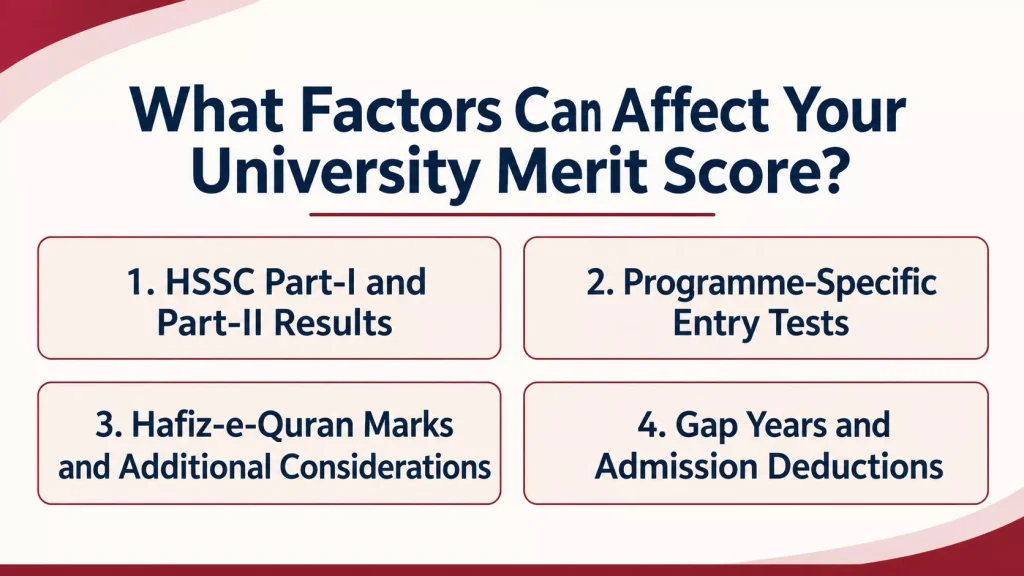
Your final admission position depends on more than your academic percentages. The following factors can influence how universities calculate or confirm merit.
1. HSSC Part-I and Part-II Results
Some universities allow students to apply before their complete Intermediate results are available.
In such cases, the university may calculate initial merit using HSSC Part-I marks. Once the complete result is announced, the university checks the final academic record against its eligibility requirements.
For example, FAST-NUCES and NUST publish provisions for using HSSC Part-I marks in relevant admission circumstances.
However, this practice is not universal. Check the admission policy of your selected university.
2. Programme-Specific Entry Tests
Different degree programmes may require different admission tests.
Examples include:
- MDCAT for medical and dental admissions.
- NET for NUST undergraduate admissions.
- ECAT for relevant UET engineering programmes.
- NTS tests for applicable COMSATS programmes.
- LAT for LLB admissions where required.
Your test score should always be calculated using the correct maximum marks and the weightage assigned by the university.
3. Hafiz-e-Quran Marks and Additional Considerations
Some universities may provide additional consideration or marks to Hafiz-e-Quran applicants, subject to their admission rules and verification procedures.
However, there is no universal bonus of 20 marks applicable to all Pakistani universities.
Applicants should check whether their selected institution offers this provision, how it is assessed and whether it affects the final aggregate.
4. Gap Years and Admission Deductions
Do not automatically deduct marks from your aggregate because you took a gap year.
Any deduction, age restriction or other admission condition must be explicitly stated in the relevant university’s current admission policy. There is no single nationwide rule establishing a universal 1% or 2% deduction for every gap year.
What Common University Admission Mistakes Should Students Avoid?
Students can make avoidable mistakes when estimating their admission merit. Keep the following points in mind:
- Using the wrong formula: Do not copy another university’s weightage. Check the criteria for your selected programme.
- Confusing eligibility with merit: Meeting the minimum percentage requirement does not guarantee admission.
- Ignoring entrance test weightage: A strong academic record may not compensate for a low entrance test score when the test carries substantial weightage.
- Delaying IBCC equivalence: Students with foreign qualifications should arrange their equivalence documents early and follow the university’s application deadlines.
- Using incomplete Intermediate marks incorrectly: If you are applying with HSSC Part-I results, follow the university’s instructions for provisional merit calculations.
- Assuming previous-year policies remain unchanged: Universities can revise admission requirements, test arrangements and merit formulas between admission sessions.
Another important distinction is the difference between your calculated aggregate and the closing merit of a programme. Your aggregate represents your score, while the closing merit indicates the aggregate of the last admitted candidate in a particular selection list or admission category.
Calculating university merit in Pakistan
Start by checking the official eligibility requirements, obtaining your academic percentages and identifying the relevant entrance test. Then calculate your aggregate using the published weightage rather than relying on a general formula. For students comparing universities and undergraduate programmes, ScholarBee can help make the university research and selection process easier.
Frequently Asked Questions
1. What is the passing aggregate for medical universities in Pakistan?
There is no single passing aggregate that guarantees admission to every medical college. Under the published PMDC criteria, applicants must pass MDCAT and meet the minimum HSSC eligibility requirement of 60%, alongside the required subject conditions. The merit calculation for public medical and dental colleges uses 50% MDCAT, 40% HSSC and 10% SSC. Actual admission depends on the merit ranking and available seats.
2. Can I get university admission based on my HSSC Part-I result?
Yes, some universities accept HSSC Part-I marks for initial or provisional merit calculations when the complete Intermediate result is unavailable. NUST and FAST-NUCES publish provisions for using Part-I marks. However, the rules differ by institution and programme, and final admission remains subject to the applicable requirements.
3. How does NUST calculate merit for undergraduate engineering?
NUST uses 75% NET, 15% HSSC and 10% SSC for its general NET-based undergraduate admissions, including engineering. Applicants should also check the programme-specific eligibility requirements.
4. How are A-Level grades converted into Pakistani marks?
A-Level grades are converted through IBCC equivalence. IBCC publishes a grade conversion table, but the final equivalence depends on the applicable subjects and examination-session requirements. Students should use the marks stated on their official equivalence certificate.
5. What happens if two students have the same merit aggregate?
Universities may apply tie-breaking rules to determine the admission order. These rules can involve entrance test marks, academic marks or other criteria specified in the admission policy. There is no universal tie-breaking procedure for every university.
6. Is an 80% merit aggregate enough for university admission in Pakistan?
An 80% aggregate may be sufficient for some programmes but not for others. Admission depends on the university, degree programme, applicant pool, available seats and closing merit. Compare your aggregate with the relevant programme’s previous closing merit lists as a reference, not as a guarantee of future admission.
7. Do all Pakistani universities give 50% weightage to entry tests?
No. Entry test weightage varies by institution and programme. For example, NUST assigns 75% to NET, while the published COMSATS 2025–26 undergraduate prospectus assigns 50% to the NTS test.
