


Quick answer: An MS is generally more suitable for students seeking advanced knowledge in a specific academic or professional field, particularly those continuing from an undergraduate degree. An MBA is designed for students seeking broader business knowledge, management skills and leadership development. Many established MBA programmes expect applicants to have professional experience. Your choice should depend on the programme’s admission requirements and the career you want to pursue, rather than the assumption that one degree is universally better.
Choosing between a Master of Science (MS) and a Master of Business Administration (MBA) depends on your academic background, professional experience, career goals and budget. Both degrees can lead to international career opportunities, but they serve different purposes.
For Pakistani students planning to study abroad in 2027, the decision also requires checking university admission criteria, tuition fees and post-study immigration rules. These requirements vary by country, university and programme.
Key Takeaways
- An MS focuses on specialised academic or professional knowledge, while an MBA focuses on business administration and management.
- MBA programmes can require substantial post-graduation work experience, but the minimum varies between universities.
- GRE, GMAT and English-language requirements depend on the university and individual programme.
- There is no single international tuition fee or graduate salary applicable to all MS and MBA programmes.
- From 1 January 2027, the UK Graduate visa will last 18 months for eligible bachelor’s and master’s graduates applying under the revised rules. Eligible doctoral graduates can receive three years.
- Pakistani applicants should check their university and qualification status through the relevant Higher Education Commission (HEC) resources where applicable.
MS vs MBA Abroad: Key Differences
The main difference between an MS and an MBA is the type of knowledge and professional development each programme provides.
An MS (Master of Science) develops advanced knowledge in a particular subject. Depending on the university, it may involve academic research, technical training, professional applications or a combination of these.
An MBA (Master of Business Administration) provides broader education in business and management. Its curriculum may cover finance, marketing, strategy, operations, organisational behaviour and leadership.
| Comparison | MS (Master of Science) | MBA (Master of Business Administration) |
|---|---|---|
| Main focus | Subject specialisation | Business and management |
| Suitable applicants | Graduates and professionals seeking specialisation | Professionals seeking business and management education |
| Academic approach | Subject-specific coursework and research, depending on the programme | Business subjects, management cases and applied learning |
| Work experience | Requirements vary by programme | Often expected or required |
| Admission tests | GRE may be required, optional or not accepted | GMAT or GRE may be required, optional or waived |
| Career direction | Specialist and subject-related roles | Management, business and leadership-related roles |
| Programme duration | Varies by university and country | Varies by university and programme |
Why Should Pakistani Students Choose an MS Abroad?
An MS can be a suitable option for Pakistani graduates who want to continue studying in their existing academic field or develop expertise in a related discipline.
For example, a graduate with a bachelor’s degree in computer science may consider postgraduate programmes in artificial intelligence, cybersecurity or data science, provided they meet the relevant admission requirements.
Benefits of an MS Abroad
1. Advanced subject knowledge
An MS allows students to study a particular subject at an advanced level. Depending on the programme, students may develop research, analytical, technical or professional skills.
2. Opportunities for academic research
Research-based master’s programmes can provide experience in research methods, academic writing and independent investigation. These programmes may be relevant to students considering doctoral studies.
3. Different programme structures
MS programmes do not follow one universal duration. Their length depends on the country, institution, study mode and course structure. Applicants should check the official programme information before planning their budget or travel.
Limitations of an MS
An MS does not automatically prepare graduates for senior management positions. Its value depends on the subject studied and the career requirements of the intended industry.
Students should also examine the programme curriculum rather than selecting a degree based only on its title. Two programmes with similar names may have different modules, entry requirements and learning outcomes.
MS Specialisations to Consider
Pakistani students can investigate postgraduate programmes in areas such as:
- Data Science and Artificial Intelligence
- Computer Science
- Cybersecurity
- Engineering
- Finance and Financial Technology
- Biotechnology
- Environmental Science
The availability of these subjects and their admission requirements must be checked with individual universities.
Why Should Pakistani Professionals Choose an MBA Abroad?
An MBA may be suitable for professionals who want to develop their understanding of business operations, management and organisational decision-making.
Unlike a specialised MS, an MBA generally covers several business disciplines. The programme may also provide opportunities to learn from classmates with different professional and educational backgrounds.
Benefits of an MBA Abroad
1. Broader business knowledge
MBA programmes commonly cover areas such as finance, marketing, strategy, operations and organisational management.
2. Professional development
Depending on the programme, students may develop skills in communication, teamwork, problem-solving, negotiation and business decision-making.
3. Professional networking
MBA classrooms often bring together students from different industries and professional backgrounds. This can create opportunities to exchange knowledge and establish professional connections.
Limitations of an MBA
An MBA can require a substantial financial commitment. Students should calculate tuition, accommodation, living expenses, insurance and other costs before accepting an offer.
Work experience is another important consideration. Some leading MBA programmes require applicants to have professional experience.
For example, the University of Oxford’s MBA requires at least two years of full-time post-graduation work experience. Its 2027–28 application requirements also specify a GMAT or GRE score. These are Oxford’s individual admission requirements, not universal MBA admission rules.
MBA Specialisations and Business Areas
Depending on the university, MBA students may study subjects related to:
- Strategic Management
- Finance
- Marketing
- Business Analytics
- Operations Management
- Entrepreneurship
- Technology Management
Applicants should review the actual curriculum to determine whether it supports their professional goals.
How Much Does an MS or MBA Abroad Cost for Pakistani Students?
The cost of studying abroad depends on the destination country, university, programme duration and personal living expenses. There is no single verified global tuition or living-cost figure that applies to all MS and MBA students.
An MBA may involve a higher total financial commitment at some business schools, but this is not a universal rule. Some specialised MS programmes can also have substantial tuition fees.
Students who need financial assistance can compare fully funded scholarships for international students to identify funding opportunities for postgraduate education.
Expenses to Include in Your Study Abroad Budget
For accurate figures, use the university’s official tuition and accommodation information and the destination country’s government immigration guidance.
| Expense | What to Check |
|---|---|
| Tuition fees | Official programme fee for your intended intake |
| Accommodation | University accommodation or private rental costs |
| Food and daily expenses | Estimated monthly living costs |
| Health insurance | Mandatory or university-required coverage |
| Visa application | Current government application fee |
| Immigration-related charges | Any applicable healthcare or insurance charges |
| Travel | Flights and local transportation |
| Study materials | Books, equipment and other course-related expenses |
What Are the Admission Requirements for MS and MBA Abroad?
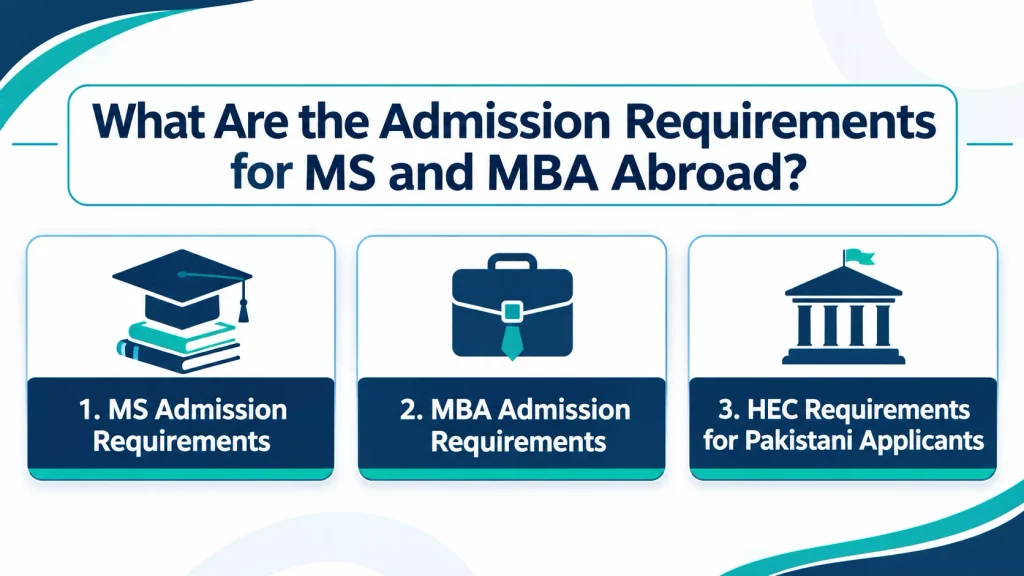
Admission requirements differ between universities and programmes. Pakistani applicants should check the official entry requirements for their intended 2027 intake before preparing an application.
MS Admission Requirements
Universities may consider the following:
- A recognised undergraduate qualification relevant to the intended programme.
- Academic transcripts and degree certificates.
- Minimum academic grades or GPA specified by the university.
- English-language proficiency evidence, if required.
- GRE scores, where applicable.
- Statement of purpose or personal statement.
- Letters of recommendation.
- Relevant academic or professional experience, where required.
A four-year bachelor’s degree may meet the academic entry requirement for many master’s programmes, but applicants must check the university’s country-specific qualification guidance.
GRE requirements are not universal. For example, MIT states that its graduate departments determine their own GRE policies. Some require scores, some make them optional, and others do not accept them.
MBA Admission Requirements
MBA applicants may need to provide:
- An undergraduate degree or equivalent qualification.
- Academic transcripts.
- A professional CV or résumé.
- Post-graduation work experience, if required.
- GMAT or GRE scores, where applicable.
- English-language proficiency evidence, if required.
- Essays or personal statements.
- Professional or academic references.
- An admission interview, where applicable.
Work experience requirements differ considerably.
For example, Oxford requires at least two years of full-time work experience gained after graduation for its MBA. Its 2027–28 admission requirements also require applicants to submit either a GMAT or GRE score.
Other universities may have different policies, including test waivers or optional standardised tests.
Important: Do not assume that every MBA requires three years of experience or that every university requires GMAT, GRE or a particular IELTS score. Always check the specific programme’s admission requirements.
HEC Requirements for Pakistani Applicants
Pakistani students should verify the recognition status of their local university and qualification through the relevant HEC resources.
The HEC maintains the Pakistan Qualification Register (PQR), which provides information about recognised higher education qualifications and their providers.
The HEC recognised universities list can also be used to check institutional recognition.
If document attestation is required for an application, HEC provides an online Degree Attestation System.
However, HEC attestation should not be presented as a universal requirement for every international university application. Check the document requirements of your chosen institution and any applicable authorities.
Is an MS or MBA Valuable If You Return to Pakistan?
Both degrees can support career development in Pakistan. Their relevance depends on the qualification, institution, subject area and professional experience.
Career Opportunities After an MS
An MS graduate may pursue opportunities related to their specialisation, including:
- Software development and computer science
- Data analysis and data science
- Engineering
- Cybersecurity
- Scientific research
- Finance and analytical roles
The actual opportunities depend on employer requirements and the applicant’s technical and professional skills.
Career Opportunities After an MBA
An MBA graduate may pursue opportunities in areas such as:
- Business management
- Financial management
- Marketing
- Operations
- Business development
- Strategy and consulting
- Entrepreneurship
An MBA does not guarantee an executive position. Employers consider professional experience, leadership ability and the relevance of the candidate’s education.
What Are the Post-Study Work Visa Rules for Pakistani Students in 2027?
Post-study work arrangements are important when comparing international study destinations. However, visa eligibility depends on immigration rules, the qualification, the institution and the applicant’s circumstances.
Two important destinations for Pakistani students are the UK and the United States. Students comparing different destinations should also consider the best countries for Pakistani students to study abroad before making their decision.
United Kingdom: Graduate Route in 2027
According to the UK government’s official Graduate visa guidance:
- Applications made on or before 31 December 2026 receive a two-year Graduate visa, subject to eligibility.
- Applications made on or after 1 January 2027 receive an 18-month Graduate visa for eligible bachelor’s and master’s graduates.
- Eligible PhD and other doctoral graduates can receive a three-year Graduate visa.
The Graduate visa cannot be extended. However, eligible applicants may be able to switch to another immigration route, such as the Skilled Worker route, if they meet its requirements.
The Graduate route is available to eligible international students who have successfully completed an eligible UK course while holding the required Student visa. It is not an automatic benefit for every international graduate.
For students planning a master’s degree in the UK in 2027, this change should be considered when evaluating the post-study employment period. The UK Government’s Graduate visa rules explain the eligibility conditions, application process and permitted stay.
United States: Optional Practical Training (OPT)
The United States offers Optional Practical Training (OPT) to eligible F-1 students.
Under the relevant rules:
- Eligible students may receive up to 12 months of post-completion OPT.
- Students who qualify under the STEM OPT extension requirements may apply for an additional 24 months.
- The STEM extension is subject to specific requirements, including an eligible STEM degree and an employer meeting the applicable E-Verify requirements.
This can provide eligible STEM graduates with up to 36 months of combined OPT authorisation. It is not an automatic benefit for every international student or every degree.
Immigration policies can change. Applicants should check the relevant government’s official guidance before making financial or academic commitments.
How Should Pakistani Students Choose Between an MS and MBA?
The right degree depends on what you want to achieve professionally and academically.
Consider an MS if you want to:
- Develop advanced knowledge in a specific subject.
- Continue your education after completing a bachelor’s degree.
- Build expertise in a technical, scientific or professional discipline.
- Prepare for research or further academic study.
Consider an MBA if you want to:
- Develop broader business and management knowledge.
- Build on your existing professional experience.
- Move towards business leadership or management responsibilities.
- Develop an understanding of different business functions.
Before deciding, compare the curriculum, admission requirements, total programme cost and post-study immigration arrangements of your shortlisted universities.
Make an Informed Decision About Your International Education
Choosing between an MS and an MBA is not simply a matter of selecting the degree with the highest potential salary. It requires understanding your academic background, professional experience, financial position and long-term career objectives. ScholarBee helps students explore international universities and programmes so they can compare their options and make informed decisions about their education.
Frequently Asked Questions
1. Can Pakistani students apply for an MBA abroad directly after a bachelor’s degree?
It depends on the university. Some MBA programmes require post-graduation professional experience, while admission policies differ across institutions. For example, Oxford requires at least two years of full-time work experience for its MBA.
2. Is the GRE compulsory for MS programmes abroad?
No. GRE requirements vary by university and academic department. Some programmes require the GRE, others make it optional, and some do not accept it. Check the official admission requirements of your intended programme.
3. Is the GMAT compulsory for MBA admission?
Not universally. Some business schools require the GMAT or GRE, while others have different testing policies or offer waivers. Applicants should check the requirements for their chosen programme.
4. Can Pakistani students apply for an MS abroad with a four-year bachelor’s degree?
A four-year bachelor’s degree may satisfy the academic qualification requirement for many postgraduate programmes. However, eligibility depends on the subject, previous qualification, academic performance and university-specific entry criteria.
5. How long is the UK Graduate visa for master’s graduates in 2027?
Eligible bachelor’s and master’s graduates applying on or after 1 January 2027 can receive an 18-month Graduate visa. Eligible doctoral graduates can receive three years.
6. Can Pakistani students get three years of work authorisation after an MS in the USA?
Eligible F-1 students can receive up to 12 months of post-completion OPT. Those who meet the additional STEM OPT requirements may qualify for a 24-month extension, providing up to 36 months in total.
7. Which degree is better for Pakistani students planning to return home?
Neither degree is universally better. An MS may be more relevant to specialist and technical careers, while an MBA may be more relevant to business and management careers. The decision should reflect the student’s intended profession and qualifications.
