Quick answer: Pakistani students can get scholarships after a study gap, provided they meet the specific scholarship and admission requirements. A gap year is not automatically disqualifying, but it does not guarantee eligibility either. There is no universal rule that all universities accept only two or three years of undergraduate study gaps or that master’s applicants can have up to ten years. Applicants must check the rules of their intended university and scholarship programme.
A study gap does not automatically disqualify Pakistani students from university admission or scholarship opportunities abroad. However, acceptance depends on the university’s admission requirements, the scholarship’s eligibility criteria, the chosen programme, and any applicable student visa rules.
Students planning to study abroad in 2027 should focus on explaining their educational history honestly, documenting relevant activities, and demonstrating why their chosen course fits their academic and career goals. There is no single study-gap limit that applies to every country, university, or scholarship.
Key Takeaways
- A study gap does not automatically make a Pakistani student ineligible for admission or a scholarship.
- Universities and scholarship providers set their own eligibility criteria; there is no universal maximum gap duration.
- Relevant work experience, exam preparation, internships, volunteering, and short courses can help explain how you spent your time.
- Keep genuine supporting documents, such as employment letters, course certificates, academic records, or relevant medical documentation.
- Student visa decisions follow the destination country’s rules. Meeting university admission requirements does not guarantee visa approval.
- Check official 2027 announcements before relying on programme-specific deadlines, eligibility criteria, or funding details.
Can You Get a Scholarship After a Study Gap?
Yes. You can apply for scholarships after a study gap if you meet the relevant programme requirements. Whether you qualify depends on factors such as your previous qualifications, academic performance, field of study, work experience, and the scholarship’s specific conditions.
For example, the United States Educational Foundation in Pakistan (USEFP) states that recent graduates are encouraged to apply for its Fulbright degree programme. It also specifies additional relevant work-experience requirements for MBA and Public Policy/Administration applicants. This illustrates why applicants should check the actual eligibility criteria instead of assuming that every scholarship treats study gaps in the same way.
A gap year may be associated with preparing for entrance examinations, gaining professional experience, managing family responsibilities, addressing health issues, or reconsidering academic plans. Explain your circumstances truthfully and provide supporting evidence where available.
Benefits of a Purposeful Gap Year
A well-used gap year can help you:
- Prepare for required admission or English-language tests.
- Gain work experience relevant to your intended degree.
- Develop skills through relevant courses or practical projects.
- Explore different academic fields before committing to a programme.
- Organise your applications, academic records, references, and funding documents.
These activities may strengthen your application, but none guarantees a scholarship or admission offer.
Drawbacks to Consider
A study gap can create challenges if you cannot clearly explain your educational history or demonstrate your readiness for the proposed course. You may also need to meet additional programme-specific conditions, such as recent academic prerequisites, relevant professional experience, or required qualifications.
The appropriate response is to identify the requirements early and prepare an honest explanation supported by the evidence you actually have.
What is the Maximum Study Gap for Scholarships Acceptable in 2027?
There is no universal maximum study-gap duration for international admissions or scholarships. The applicable rule depends on the institution, course, scholarship, and, where relevant, immigration requirements.
| Academic level | What applicants should check |
|---|---|
| Undergraduate or bachelor’s degree | Previous qualifications, subject prerequisites, entry grades, qualification validity, and any institution-specific time limits |
| Diploma or vocational programme | Admission requirements, previous education, relevant experience, and programme-specific eligibility conditions |
| Master’s degree | Bachelor’s degree requirements, academic background, relevant experience where required, and scholarship eligibility |
| PhD or doctoral programme | Previous postgraduate qualifications, research proposal requirements, academic preparation, and funding criteria |
Do Undergraduate Applicants Face Stricter Gap Rules?
Some undergraduate programmes have specific academic prerequisites or qualification requirements, but it is not accurate to claim that all universities accept only two or three years of study gaps.
If you completed your FSc or A-Levels several years ago, contact the admissions office of your intended institution. Ask whether your qualification remains acceptable, whether any subject prerequisites apply, and whether additional documents are required.
Pakistani students preparing for MDCAT, ECAT, SAT, or other entrance examinations should retain relevant results and records where available. These documents can help explain their academic timeline, although they do not replace the university’s entry requirements.
Can Master’s Applicants Apply After Five or Ten Years?
Possibly. A long gap does not automatically determine eligibility for every master’s programme. However, applicants must meet the programme’s academic requirements and any additional conditions.
Professional experience may be relevant to some courses and scholarships, while other programmes may focus more heavily on academic qualifications or research preparation. Applicants should confirm the specific requirements instead of assuming that all postgraduate programmes accept gaps of a particular length.
How Should You Use a Gap Year to Improve Your Scholarship Profile?
The most useful activities are those that support your intended degree, develop relevant skills, or help you meet a stated admission requirement. Choose activities you can complete meaningfully and document honestly.
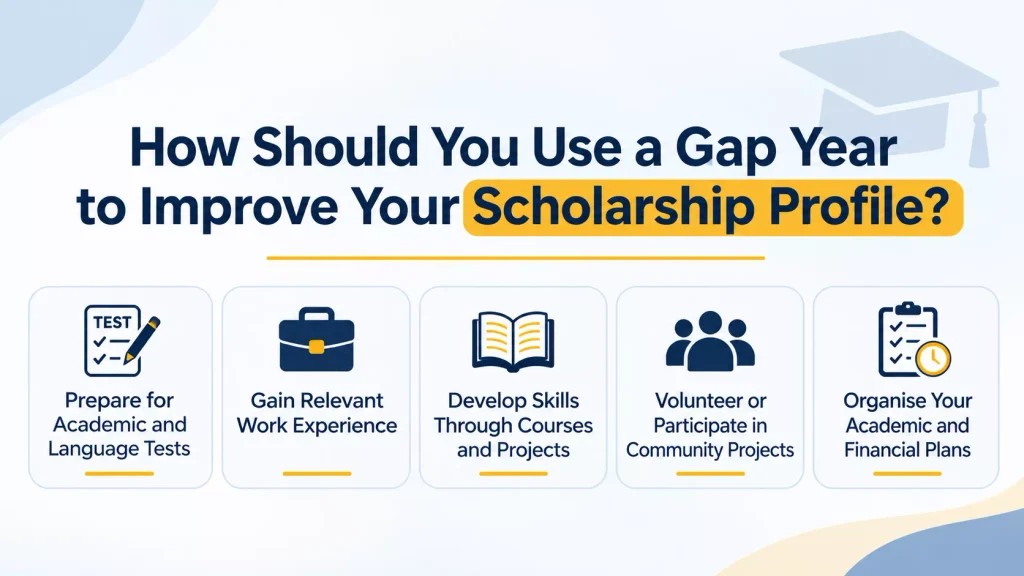
1. Prepare for Academic and Language Tests
If your intended university requires an entrance examination or English-language test, use your time to prepare.
Depending on the programme, relevant tests may include the SAT, GRE, or an approved English-language assessment. Not every university or scholarship requires these examinations, so verify the requirements before paying for a test.
Keep official score reports and registration records where relevant. Do not assume that a higher test score automatically results in a scholarship.
2. Gain Relevant Work Experience
An internship, job, research placement, or practical project can help you develop skills relevant to your intended field.
For example, an applicant planning to study computer science could gain programming experience, while someone interested in public policy might contribute to a research project or work in a relevant organisation.
Keep accurate records of your role, responsibilities, dates, and achievements. Check whether your target scholarship specifically requires professional experience, because work experience is not a universal requirement for all scholarships.
3. Develop Skills Through Courses and Projects
You can use your gap year to build practical skills through relevant online courses, workshops, or independent projects.
Choose learning opportunities that match your academic goals. Verify whether a course provides a certificate, what the certificate represents, and whether the institution you are applying to recognises it.
A certificate can demonstrate learning, but it does not automatically count as an accredited qualification or replace formal entry requirements.
4. Volunteer or Participate in Community Projects
Volunteering can help you develop teamwork, communication, organisation, and leadership skills. It may also provide useful experience for programmes that explicitly assess community engagement or leadership.
If you volunteer with a local charity, educational organisation, or community initiative, keep genuine records of your responsibilities and participation.
Do not assume that volunteering is compulsory for every scholarship or that it guarantees a stronger application. Its relevance depends on the selection criteria.
5. Organise Your Academic and Financial Plans
Use the gap period to research tuition fees, living costs, available funding, application deadlines, and the documents required for your intended programme.
If you work during this period, keep accurate employment and income records. Personal savings may contribute to your education costs, but having a job or showing income does not automatically satisfy a country’s student visa financial requirements.
Check the official financial requirements for your destination and application date before preparing your budget.
How Do You Document a Study Gap for University Admission and Student Visas?
Keep an accurate timeline of your education and activities, and use scholarship documents checklist to organise the supporting records required for your applications. The documents you need will depend on your circumstances and the requirements of your university, scholarship provider, or immigration authority.
| Reason for study gap | Potential supporting evidence |
|---|---|
| Employment | Employment or appointment letters, payslips where available, and employer references |
| Exam preparation | Official examination results, registration records, or relevant preparation records |
| Short courses or training | Course certificates, completion records, or project evidence |
| Volunteering | Confirmation letters or records from the organisation |
| Family responsibilities | A truthful written explanation and relevant supporting documents, where available |
| Health-related circumstances | Relevant medical documents, if necessary and appropriate |
| Personal or career planning | A clear explanation supported by genuine records of activities undertaken |
What Should Your Study Gap Explanation Include?
Your explanation should be concise, accurate, and consistent with your academic records and application documents. You can also use these scholarship motivation letter guidelines when preparing an explanation of your background, relevant experience, and future academic goals.
Cover three points:
- What happened: Explain why you did not continue your studies immediately.
- What you did during the gap: Describe your actual activities, responsibilities, preparation, or circumstances.
- Why you are ready now: Explain how your current plans connect to the course you want to pursue.
Avoid inventing achievements, exaggerating work experience, or claiming that a gap was planned if it was not. An honest explanation is preferable to an unsupported story designed to impress a selection committee.
Do You Need to Explain Your Gap in a Student Visa Application?
Visa requirements vary by destination. A university’s willingness to admit you does not guarantee that an immigration authority will approve your visa.
For example, Australia’s Department of Home Affairs applies a Genuine Student requirement that considers whether studying is the applicant’s primary purpose and examines relevant circumstances. Canada’s official study-permit guidance sets out document requirements, including a letter of acceptance and proof of financial support, where applicable.
Applicants should read the official instructions for their intended destination and follow the document checklist generated for their own circumstances. A study gap alone should not be assumed to guarantee either approval or refusal.
When Can a Study Gap Affect Scholarship or Admission Chances?
A gap may become a concern when it creates an unresolved question about eligibility, academic preparation, or the applicant’s reasons for choosing a particular programme.
Pay particular attention to these situations:
- Missing prerequisites: You no longer meet a programme’s stated academic or subject requirements.
- Unclear academic history: Your application contains unexplained dates or inconsistencies.
- Insufficient required experience: You have not met a scholarship’s specific work-experience conditions.
- Weak course rationale: You cannot explain how the proposed degree relates to your background and future plans.
- Incomplete documentation: You have not submitted required records or explanations.
- Incorrect visa assumptions: You rely on general advice instead of checking the current immigration requirements.
The best approach is to identify the relevant conditions before applying. Do not assume that a long gap is automatically disqualifying, but do not assume it will be overlooked either.
What Should Pakistani Students Do for the 2027 Intake?
If you plan to apply for the 2027 intake, follow this practical process:
- Shortlist suitable programmes. Identify universities and scholarships that match your qualifications and intended field.
- Check official eligibility criteria. Review academic requirements, experience conditions, age limits where applicable, and any published restrictions.
- Confirm the gap policy. Look for an explicit maximum duration. If none is stated, ask the admissions office or scholarship provider.
- Prepare your explanation. Write a truthful timeline covering your education and the activities or circumstances during the gap.
- Collect supporting documents. Obtain relevant records from employers, educational institutions, or other appropriate sources.
- Check visa requirements separately. Admission and scholarship eligibility are different from immigration approval.
- Verify dates before submitting. Use the official programme page for the applicable intake and confirm whether the 2027 application cycle is open.
If 2027 eligibility details have not been published, do not rely on an assumed update or treat 2026 conditions as confirmed 2027 rules. Check the official website again when the new announcement becomes available.
Study Abroad Opportunities
A study gap does not automatically end your chances of studying abroad or receiving a scholarship. Start by checking official university and scholarship criteria rather than relying on general claims about how many gap years are acceptable. Keep genuine records of your activities and verify student visa requirements separately. ScholarBee helps Pakistani students organise their study-abroad research, compare suitable opportunities, and prepare for the application process.
Frequently Asked Questions
1. Can I get a fully funded scholarship after a two- or three-year study gap?
Yes, it may be possible. Eligibility depends on the scholarship’s criteria, your qualifications, and any other conditions. There is no universal rule guaranteeing acceptance after a particular number of years.
2. Can I apply for a scholarship after a five- or ten-year gap?
Some programmes may consider applicants with long gaps, particularly where relevant qualifications and any required professional experience are present. Others may have specific eligibility restrictions. Check the official programme rules before applying.
3. Does a study gap affect HEC degree attestation in Pakistan?
Do not assume that a study gap automatically affects or has no effect on a particular attestation case. Check the Higher Education Commission’s current degree-attestation requirements and contact HEC if your circumstances raise a specific question. University admission, scholarship eligibility, and degree attestation are separate matters.
4. Can I apply for scholarships if I am over 30?
Possibly. Age restrictions differ by programme, and some scholarships specify age-related conditions while others do not. Check the official eligibility criteria for the specific scholarship and intake.
5. How can I prove that I spent my gap year preparing for examinations?
Keep genuine records, such as official examination registration documents, score reports, or relevant course-completion records. Submit only documents that are relevant to the application and meet the institution’s requirements.
6. Is working in a family business a valid reason for a study gap?
It can be a legitimate explanation of your circumstances. Describe your actual role and responsibilities honestly. If supporting evidence is needed, relevant business records or a letter confirming your duties may help, subject to the requirements of the university, scholarship provider, or immigration authority.